Philip M. Bromberg on Therapy as a Negotiation of Otherness

Surfing at Wind & Sea, La Jolla, California, February 2008 by Bengt E Nyman. Licensed under CC BY 2.0.

Sooner or later, “the shadow of the tsunami” [of unhealed developmental trauma] will be evoked, bringing with it an enacted reliving of the original relational context that led to its existence, and for more individuals than one might imagine, evoking an affective memory of sliding into the abyss of depersonalization — the edge of annihilation.

For all such patients, any apparent failure of their dissociative mental structure to do its “proper” job makes their highest priority the restoration of stability, which in therapy means, “keep your hands off my ability to put things out of my mind.”

A patient chooses to see a therapist because of an implied promise that she may become more able to live her life with well-being, spontaneity, and creativity, but most patients for whom developmental trauma is a big issue have already settled for relative stability through believing that “the only safe hands to be in are my own, and you are not me,” which is why the heart of therapy is about negotiation of otherness.

The therapist’s goal of helping them restore their right to exist as a whole person has to earn its place in the analytic relationship and, paradoxically, it is earned because of the patient’s misgivings, not in spite of them.

from Bromberg, P. M. (2011). The Shadow of the Tsunami: And the Growth of the Relational Mind (1st ed.). Taylor & Francis.

Tamsin Shaw on Sadism as a “Perpetual Subterranean Force”

There are those who enjoy spectacles of cruelty. “We” are not all “decent people” who will absorb the correct moral lesson. Sadism is a perpetual subterranean force that the politics of hate can unleash.

This was shown most devastatingly in the cruelty exhibited by many Germans and their allies during the Holocaust. After the war, [political theorist Hannah] Arendt and [social psychologist Stanley] Milgram inadvertently encouraged a mischaracterization of the Nazis’ motives. Much of the killing of Jews was not done in an orderly fashion at concentration camps (which in any case constituted, as Abram de Swaan put it in his 2015 book “The Killing Compartments,” scenes of “obscene savagery and gory barbarity”) but rather at killing sites where local conscripts engaged in a wild collective frenzy, with victims being humiliated and tortured before they were killed.

But what Milgram and his generation did was to create the illusion that science could comprehend human behavior and therefore control it. Irrational delight in cruelty was written out of the story.

from Shaw, T. (2021, August 17). The Morally Troubling “Dirty Work” We Pay Others to Do in Our Place. The New York Times. https://outline.com/bnMt3c

“This Jungian Life” Podcast: The Wounded Healer

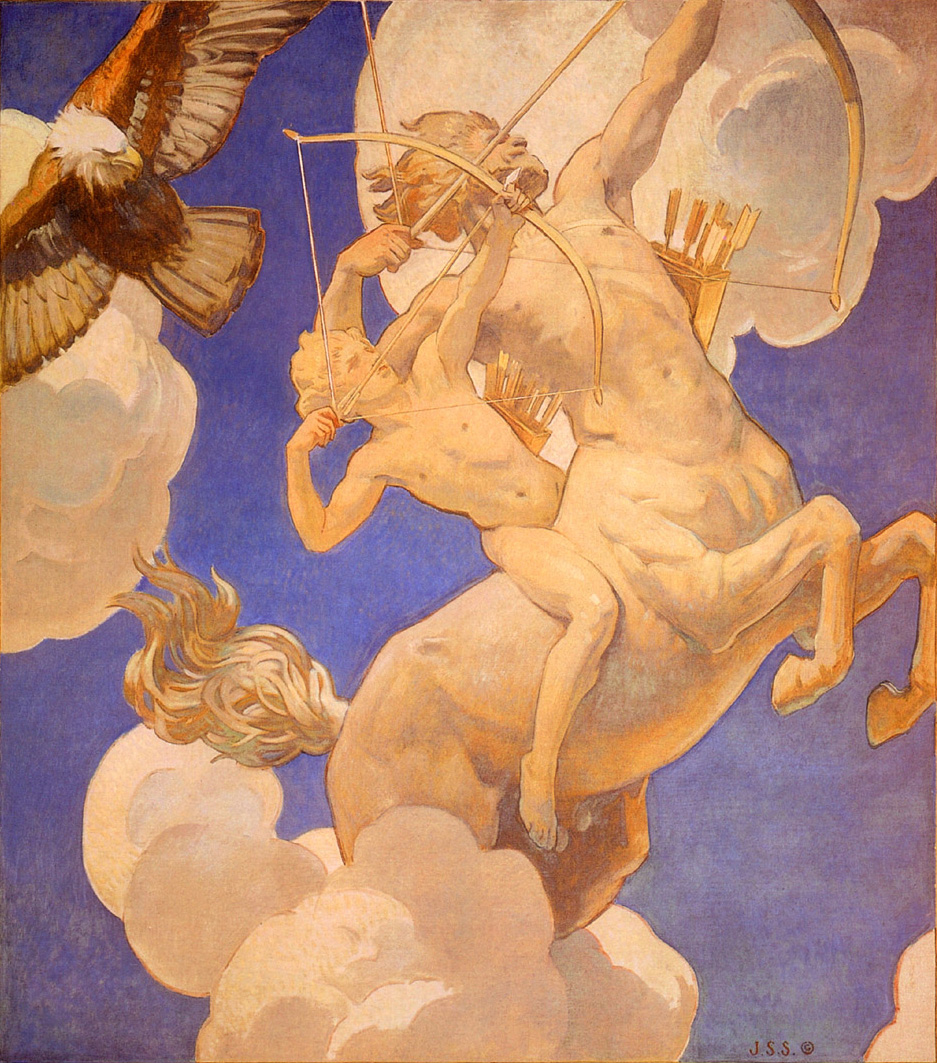
Chiron and Achilles. John Singer Sargent, circa 1922-1925. Museum of Fine Arts, Boston MA. Source: Wikimedia Commons in the public domain.

In Greek myth, Chiron symbolizes the wounded healer, a term [Carl Gustav] Jung originated. A wise and noble centaur, Chiron suffered a painful, incurable wound—and inspired many a Greek hero to reach full potential.

Psychotherapy and psychoanalysis attract wounded healers. A recent survey shows that 82% of applied psychology graduate students and faculty in the U.S. and Canada experience mental health conditions (Victor et. al., 2021). We must be willing, like Chiron, to embrace the darkness of our painful places if we hope to help others embrace theirs.

from Stewart, D., Marchiano, L., & Lee, J. (2021, August 12). Episode 176 – The Wounded Healer – This Jungian Life.

Victor, S. E.; Schleider, J. L.; Ammerman, B. A.; Bradford, D. E.; Devendorf, A.; Gunaydin, L. A.; Hallion, L. S.; Kaufman, E.; Lewis, S.; & Stage, D. ’rae. (2021). Leveraging the Strengths of Psychologists with Lived Experience of Mental Illness. https://doi.org/10.31234/osf.io/ksnfd