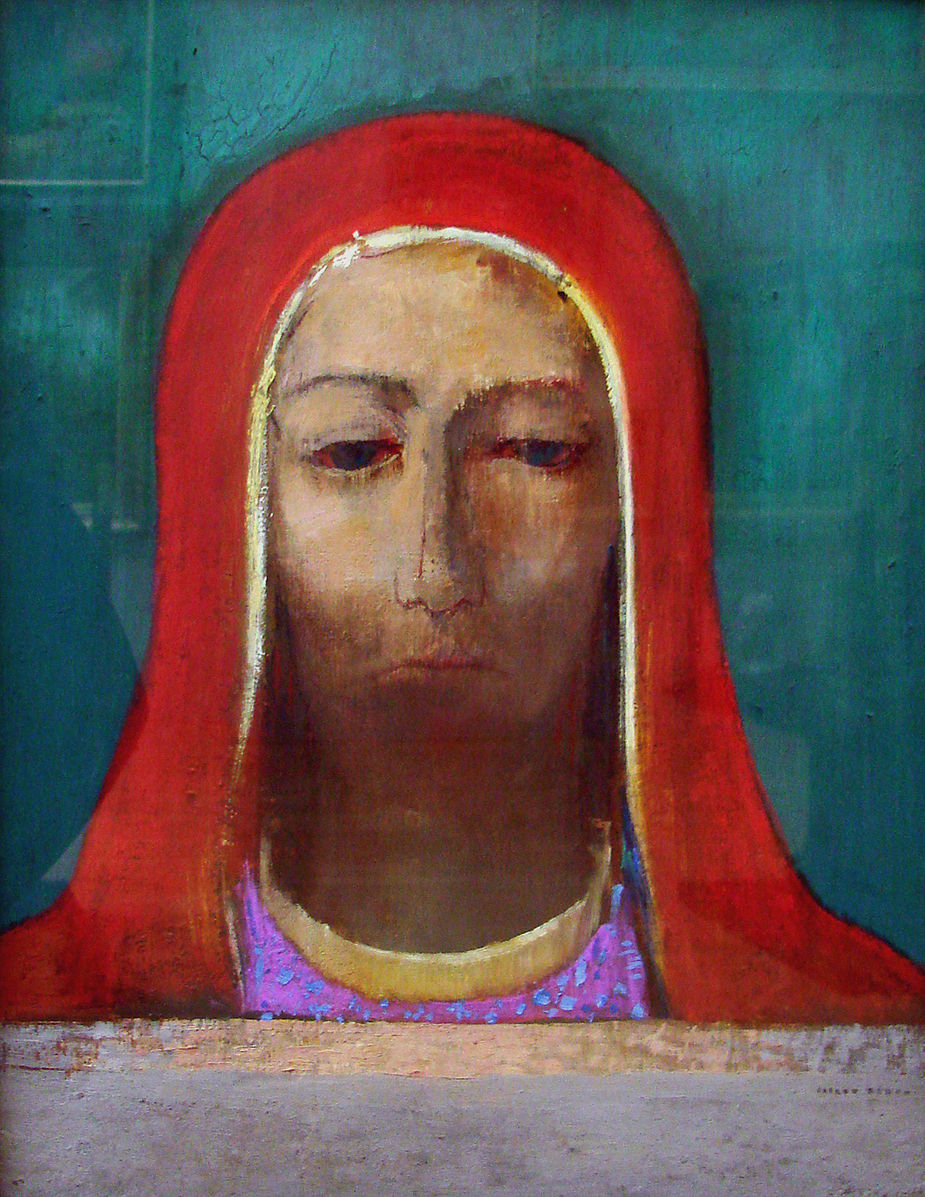
Le Silence. Painting by Odilon Redon. Circa 1895-1990. Musée d’Orsay. Work in the public domain.
In the traumatized patient, the capacity to tolerate frustration, to delay action in favor of thoughtful contemplation, to freely verbalize feelings and fantasies with preservation of self-observation and reflection are extremely important.
These skills are important for all analytic work, but they are particularly pertinent in the traumatized patient because the original traumatic situation is always speechless.
Speech is impossible during acute traumatization, and the frozen cognition, the strangulated affects of silence or screams, and the motor tendencies toward flight, fight, or chaotic thrashing all have to be ultimately replaced by verbalization. The fantasies in which the trauma has been embedded, embellished, elaborated, and validated have to be repeatedly verbalized as a central part of analytic work.
— from Blum, H. (1990). The influence of trauma on the opening phase of analysis. In T. J. Jacobs & A. Rothstein (Eds.), On beginning an analysis (pp. 67–81). International Universities Press.
Land’s End, Golden Gate National Recreation Area, San Francisco, California. Author: Matthew M. Sholler. All rights reserved.
Psychological health is not merely the absence of symptoms; it is the positive presence of inner capacities and resources that allow people to live life with a greater sense of freedom and possibility.
— from Shedler, J. (2010). The efficacy of psychodynamic psychotherapy. The American Psychologist, 65(2), 98–109. https://doi.org/10.1037/a0018378
On psychotherapy as a cultural artifact, not a ‘universal healing technology’
Psychotherapist and hermeneuticist Philip Cushman, Ph.D, 1945-2022
“Psychotherapy has had many faces and utilized many ideologies during its stay in America. Several schools, such as nineteenth-century mesmerism, were considered in their time to be undeniably scientific and remarkably, almost magically, effective. Currently, the field continues to have its trends, its scientific claims, and its occasional superstars. The post-World War II era is the product of an individualism no longer leavened by a moral tradition of political discourse and communal values. American individualism, bereft of its once vibrant commitment to communalism, and under the enormous pressures of industrial capitalism, has all too often been used as a tool to promote consumerism and to bust unions.
“In the course of this book, I will argue that the current configuration of the self is the empty self. The empty self is a way of being human; it is characterized by a pervasive sense of personal emptiness and is committed to the values of self-liberation through consumption. The empty self is a perfect complement to an economy that must stave off economic stagnation by arranging for the continual purchase and consumption of surplus goods.
“Psychotherapy is the profession responsible for treating the unfortunate personal effects of the empty self without disrupting the economic arrangements of consumerism. Psychotherapy is permeated by the philosophy of self-contained individualism, exists within the framework of consumerism, speaks the language of self-liberation, and thereby unknowingly reproduces some of the ills it is responsible for healing. None of this is an accident. The self is a product of the complex, awe-inspiring cultural process that weaves together various elements of a society in order to perpetuate the status quo. The empty self is configured to fit our particular culture; it makes for a great deal of abundance and stimulation, isolation and loneliness.
“Notice that I am treating psychotherapy as a cultural artifact that can be interpreted, rather than as a universal healing technology that has already brought a transcendent ‘cure’ to earthlings. As a matter of fact, nothing has cured the human race, and nothing is about to. Mental ills don’t work that way; they are not universal, they are local. Every era has a particular configuration of self, illness, healer, technology; they are a kind of cultural package. They are interrelated, intertwined, interpenetrating. So when we study a particular illness, we are also studying the conditions that shape and define that illness, and the sociopolitical impact of those who are responsible for healing it.”


 Matthew M. Sholler, Psy.D.
