Lao Tzu on choosing a past to build upon

Frozen Moat Outside City Walls. Jan Asselijn. Oil on canvas, circa 1647. Worcester Art Museum. Work in the public domain of the United States.

18. Second bests

In the degradation of the great way
come benevolence and righteousness.
With the exaltation of learning and prudence
comes immense hypocrisy.
The disordered family
is full of dutiful children and parents.
The disordered society
is full of loyal patriots.

— from Lao Tzu: Tao Te Ching: A book about the Way and the power of the Way (U. K. Le Guin, trans.; First edition). (1997). Shambhala.

“Reading the Tao Te Ching today, knowing what we now know about the history of China after its creation, it is easy to overlook the fact that the Tao Te Ching came first and the Confucianism we know about, the ruling religious/political system of China, came later. The author of the Way Virtue Classic was one of a small number of men in history gifted with, or cursed with, the ability to observe the beginnings of social phenomena and know where they will lead.

“Cursed, I say, because such people are destined to be ignored, disbelieved, and belittled by those around them who have no such ability. The majority of people in any society are carried along by social trends as leaves are carried along by the current of a stream. Later, with hindsight, they can look back and see that the prophets and their prophecies were correct. But by then, it is usually too late.

“What I believe the author is saying here and there in his writing is that Master K’ung [Fu-tzÅ«, Confucianism’s founder] chose the wrong past to emulate. There was an older past, which, paradoxically, could have been built upon to help Chinese society move forward—a past in which people had lived in harmony with nature.

“In that time, people recognized that nature’s wisdom and power were far greater than their own, so they aligned themselves with her and lived their lives accordingly, without the superimposed rules and regulations of a Confucian system. That was the time before The Great Way was abandoned.”

— from Hoff, B. (2021). The eternal Tao Te Ching: The philosophical masterwork of Taoism and its relevance today. Harry N. Abrams.

Iain McGilchrist: ‘Relationships are More Foundational than the Things Related’

Cerebral hemispheres. Source: Database Center for Life Science (DBCLS). Licensed under CC BY-SA 2.1 JP.

‘The world is not just a set of separately existing localized objects, externally related only by space and time,’ writes Tim Maudlin, Professor of Philosophy and Physics at NYU. ‘Something deeper, and more mysterious, knits together the fabric of the world.’ 6 Indeed, according to Richard Conn Henry, Professor of Physics and Astronomy at Johns Hopkins, ‘to see the Universe as it really is, we must abandon our tendency to conceptualize observations as things.’ 7

Reductionism envisages a universe of things — and simply material things at that. How these things are related is viewed as a secondary matter. However, I suggest that relationships are primary, more foundational than the things related: that the relationships don’t just ‘connect’ pre-existing things, but modify what we mean by the ‘things,’ which in turn modify everything else they are in relationship with.

That is because what we are dealing with are, ultimately, relations, events, processes; ‘things’ is a useful shorthand for those elements, congealed in the flow of experience, that emerge secondarily from, and attract our attention in, a primary web of interconnexions. I have nothing against things, provided we don’t see them as primary.

In our ordinary ways of thinking, things must be established before there can be relationships, and so this about-turn should seem paradoxical; but as I shall explain, paradox very often represents a conflict between the different ‘takes’ afforded by the two hemispheres [of the brain]. However, we must also be prepared to find that, as Niels Bohr recognised, whereas trivial truths manifestly exclude their opposites, the most profound truths do not. 8

This is itself a version of the realisation that what applies at the local level does not necessarily apply in the same way at the global level. The failure to observe this principle underlies some of the current misconceptions of both science and philosophy.

I believe that nowadays we live no longer in the presence of the world, but rather in a re-presentation of it. The significance of that is that the [brain’s] left hemisphere’s task is to ‘re-present’ what first ‘presences’ to the right hemisphere. This re-presentation has all the qualities of a viritual image: an infinitely thin, immobile fragment of a vast, seamless, living, ever-flowing whole.

From a standpoint within the re-presentation, everything is reversed. Instead of seeing what is truly present as primary, and the representation as a necessarily diminished derivation of it, we see reality as merely a special case of our representation — one in which something is added in to ‘animate’ it. In this it is like a ciné film that consists of countless static slices requiring a projector to bring it back into what at least looks to us like a living flow.

On the contrary, however, reality is not an animated version of our re-presentation of it, but our re-presentation a devitalized version of reality. It is the re-presentation that is a special, wholly atypical and imaginary, case of what is truly present, as the filmstrip is of life — the re-presentation is simply what one might call the ‘limit case’ of what is real.

Stepping out of this world-picture and into the world, stepping out of suspended animation and back into life, will involve inverting many of our perhaps cherished assumptions.

from McGilchrist, I. (2021). The Matter with Things: Our Brains, Our Delusions, and the Unmaking of the World. Perspectiva Press.

6 Maudlin, T. (1998). Part and whole in quantum mechanics. In E. Castellani (Ed.), Interpreting Bodies: Classical and Quantum Objects in Modern Physics (pp. 46–60). Princeton University Press.
7 Henry, R. C. (2005). The mental universe. Nature, 436(7047), 29. https://doi.org/10.1038/436029a
8 See pp. 641 & 813-6

Quote from Friedrich Nietzsche

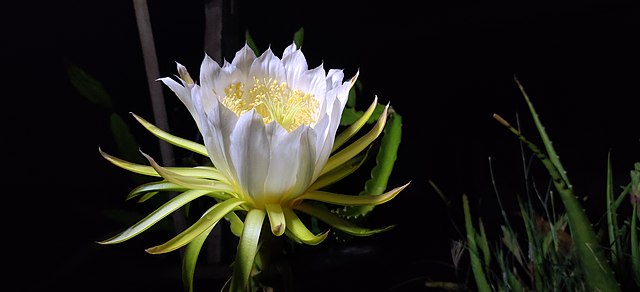
Night-blooming flower, Hylocereus undatus. Credit: Krishna Satya 333. Licensed under CC0 1.0.

I am a forest, and a night of dark trees: but he who is not afraid of my darkness, will find banks full of roses under my cypresses.

Friedrich Nietzsche, German philosopher, cultural critic, poet, and philologist