Steven Stern on the Structure of Our Self-Experience

If we think of childhood, as the infant researchers do, as a series of intersubjective moments or interaction sequences [with a caregiver], within each sequence the child brings a primary subjective experience [authentic sense of self, or “true self”], which is met by some response or initiative from the caregiver.

Over the course of each interactive sequence, the inner state [of authenticity] that the child started with is transformed by the interaction; and, through many repetitions of similar moments, the infant forms and internalizes representations of that transformational interaction sequence. Such presymbolic, internalized representations are thought to form the basis of psychological structure (e.g., Stern, 1985; Beebe, Lachmann, and Jaffe, 1997; Beebe and Lachmann, 1998).

What [Christopher] Bollas’ model would have us focus on, however, is the relationship between what the child learns and internalizes from these interaction sequences and the original subjective states [of authenticity] that the child brought to the inteactions in the first place. As I conceptualize the self, it is this intrapsychic relationship [between authenticity and our experiences of the responses of others] that determines the momentary quality of self-experience.

from Stern, S. (2002). The Self as a Relational Structure: A Dialogue with Multiple-Self Theory. Psychoanalytic Dialogues, 12(5), 693–714.
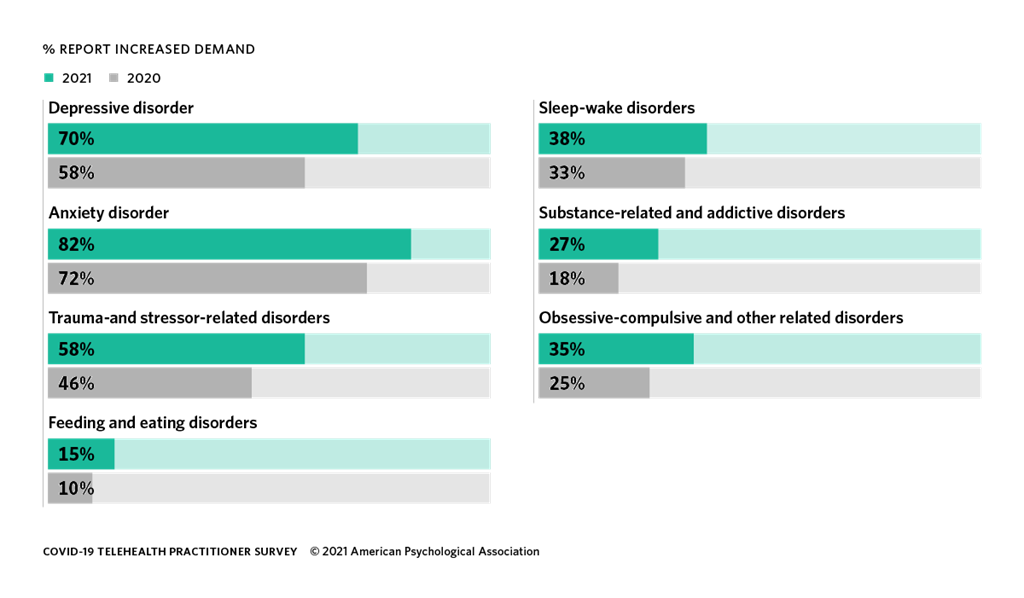

APA report: Worsening mental health crisis pressures psychologist workforce

In this 2021 follow-up survey, many psychologists reported increases in demand for treatment of anxiety and depression. Additionally, many psychologists reported increased workloads, longer waitlists, and low capacity for new patients.

Most psychologists continued to see at least some patients remotely, while a greater proportion used a hybrid model, treating some patients in person and some remotely. Despite an increased number of psychologists reporting that they were able to maintain positive work-life balance and practice self-care compared with 2020, reports of burnout and the inability to meet patient demand have also increased in the same time frame.

2021 COVID-19 Practitioner Survey. (2021). American Psychological Association.

Stephen D. Purcell on Dissociation and the Limitations of Verbal Conversation in Therapy

John, a profoundly traumatized person, […] alluded to the non-representational aspect of dissociation this way:

“If the mind is overwhelmed, the brain has other tools for survival. There are no words for that.”

It is important “technically” to recognize that there simply cannot be a therapeutic verbal conversation about unrepresented affects. The main point here is that dissociated affective experience shows up not in what is talked about but, alternatively, manifests itself in the various actions that occur in the setting of psychoanalysis.

In addition to allowing a proper place for the lack of [personal] agency, an appreciation of the centrality of unrepresented affective experience in dissociative psychopathology and, consequently, of its necessary and inevitable enactment in analysis are other essential perspectives in the development of a comprehensive clinical theory. Something additional to verbal (symbolic) conversation must find its way into our clinical practice and theory.

Purcell, S. D. (2019). Psychic song and dance: Dissociation and duets in the analysis of trauma. The Psychoanalytic Quarterly, 88(2), 315–347.