
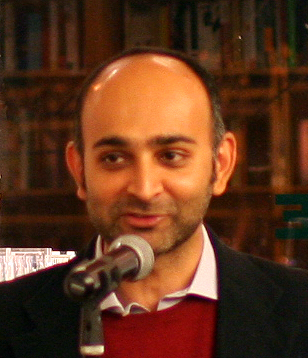
Ezra Klein: I’m curious, for you, about the practice, the discipline of trying to be able to imagine and articulate better futures, even as you try to be realistic about the present.
Mohsin Hamid: Well, I think that it’s always worth interrogating why we do stuff. And if you take, for example, a kind of pessimistic acceptance, which is not longing for the past, but a sense that the things that one wishes for — a more inclusive society, a less racist society, a more equal society — are slipping away for complicated reasons, and nothing can be done — the environment is just going to go to pot, and that’s sort of it.
The other part of it, though, is that it is incredibly difficult to reckon with this feeling of defeat, of loss. It isn’t “I seem to be losing out, the world is going in the wrong direction.” [It’s] “How do I survive this? How do I deal with my profound sense of despair at the situation?”
And human life, I think, is a good parallel. So of course, we’re all going to get older. You know, of course, we’re all going to die. What is our stance in relation to that?
So it would be ridiculous to say, “Well, this is never going to happen to me. I feel like there’s a way out of this. I’m going to eat something or get an injection or something will happen, and it’s going to save me.” I can understand the appeal, but it seems profoundly misguided, as far as I can see.
It’s the optimism of “I have something of value yet to give, and it is meaningful for me to pass that on.”
Mohsin Hamid
But also to say, “You know what, I’m going to get old, nothing can be done, let’s just carry on.” It’s an interesting response, right? It’s entirely possible that we do learn something, that there is some wisdom.
And in [Hamid’s book, The Last White Man], for example, there’s the character of Anders’s father, who’s ill and who is dying, and whose mission, in a way, is to try to somehow pass on to his son how you die well. You know, what could this mean? What is it to do this thing? And in a sense, that is a, I think — Anders’s father has all sorts of views that I might not agree with, but in that particular attempt to pass on to his son something of meaning and something of wisdom from the old and from those near to mortality to those who are young, there is an activity there. And that’s something that the elders of every tribe throughout human history have done towards the young in their tribe forever.
We, I think, should consider that. And what kind of optimism does that mean? It’s not the optimism of “I will live forever.” It’s the optimism of “I have something of value yet to give, and it is meaningful for me to pass that on.” And so I suppose what I would come to on this is that the reaction of a kind of pessimistic acceptance, to me, feels like it is less than what could be hoped for. It is possible to try for more than that. And I think that, as a writer and as an artist, but also as a father and as a human being, it isn’t — while it’s understandable to me, it isn’t appealing to me.
— from Hamid, M., & Klein, E. (2022, August 12). How do we face loss with dignity? The Ezra Klein Show.
Discover more from Matthew M. Sholler, Psy.D.
Subscribe to get the latest posts sent to your email.
 Matthew M. Sholler, Psy.D.